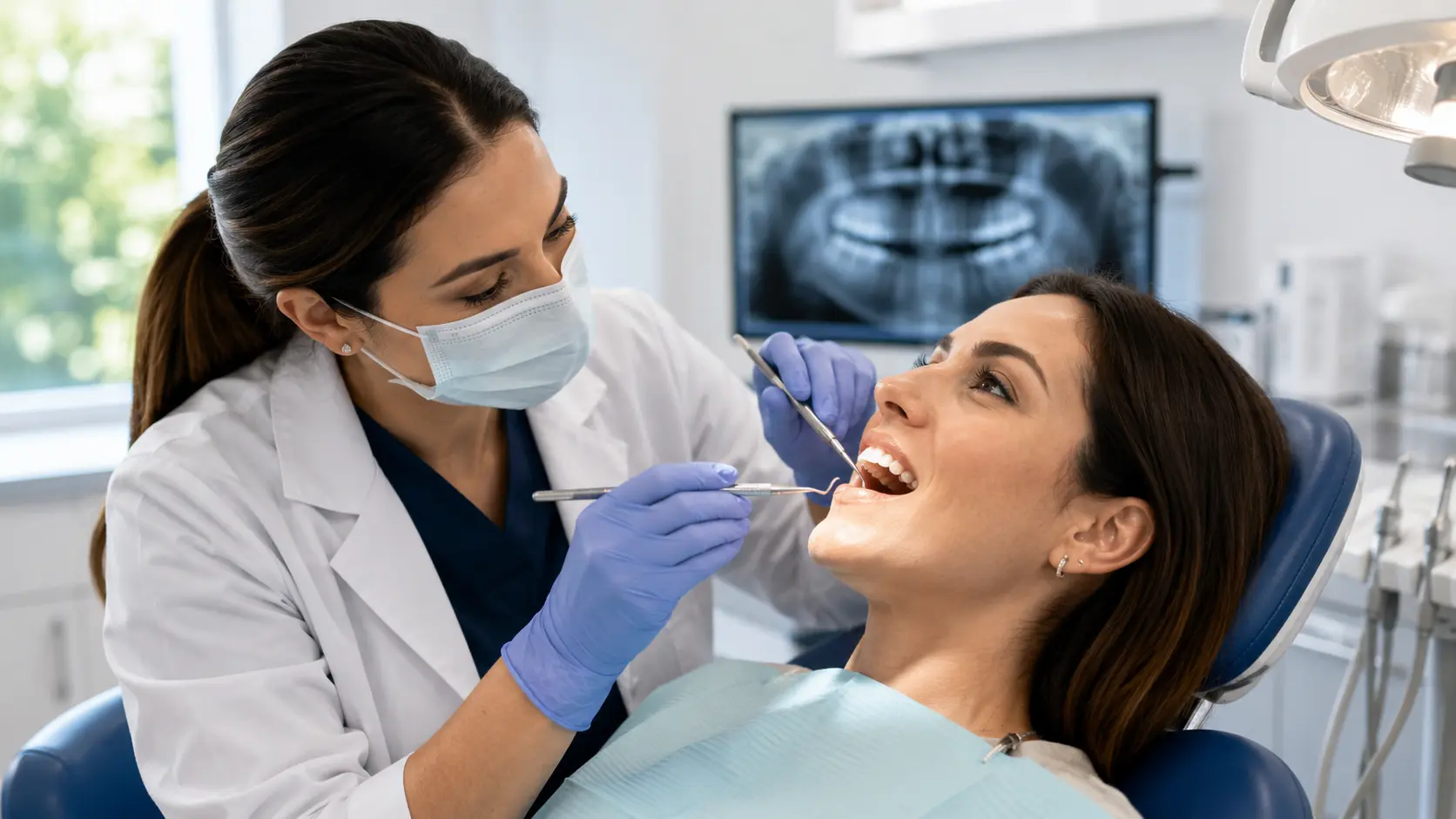

What Is Scaling and Root Planing?
Scaling and root planing is a two-part, non-surgical procedure designed to treat gum disease at the source.- Scaling removes plaque and hardened tartar from the tooth surface and, more importantly, from below the gumline where a regular cleaning can’t reach.
- Root planing smooths the root surfaces of the teeth. This matters because rough root surfaces give bacteria more places to grip and rebuild, while smooth surfaces make it easier for gum tissue to reattach and heal.
How a Periodontist Determines If You Need It
Not every patient with gum irritation needs scaling and root planing. A periodontist makes this determination using a few specific measurements:- Pocket depth readings. Healthy gum pockets measure 1–3mm. Depths beyond that indicate the gum has started to separate from the tooth, a sign of active disease.
- Bleeding on probing. Gums that bleed easily during a routine exam often signal inflammation below the surface.
- Bone loss visible on X-rays. This helps distinguish early gingivitis, which is reversible, from periodontitis, which has already affected the supporting bone.
- Tartar location. Buildup below the gumline, which a toothbrush and floss cannot remove, is the clearest indicator that professional intervention is needed.
What Happens During the Procedure
For most patients, scaling and root planning is more comfortable than they expect. Here’s the general process:- Local anesthesia is applied to numb the treatment area so the procedure itself is not painful.
- Scaling is performed using ultrasonic instruments and hand tools to break up and remove tartar above and below the gumline.
- Root planing follows, smoothing the exposed root surfaces to discourage future bacterial buildup and encourage gum reattachment.
- Localized antibiotics may be placed directly into deeper pockets to reduce bacteria and support healing, particularly in areas with more advanced inflammation.
Recovery Timeline: What to Expect
Recovery from scaling and root planing is generally short, but knowing what’s normal helps you avoid unnecessary worry.- First 24–48 hours: Mild soreness, sensitivity to hot or cold, and slightly tender or swollen gums are common. Over-the-counter pain relief and a soft-food diet usually help.
- Days 3–5: Sensitivity typically starts to fade. Gums may still look slightly red as they heal.
- 1–2 weeks: Gum tissue begins to tighten back around the teeth as inflammation subsides. Any lingering tenderness should be resolved by this point.
- 4–6 weeks: This is when a periodontist typically reevaluates pocket depths to measure how well the tissue has responded and whether further treatment is needed.
A Typical Patient Journey
To put this into perspective, consider a common scenario: a patient in their 40s notices bleeding while flossing over several months and assumes it’s just aggressive brushing. At a routine exam, pocket depths of 4–5mm are found in several areas, along with early bone loss on X-ray, consistent with moderate periodontitis. Scaling and root planing is recommended and completed over two visits, one week apart. The patient reports mild soreness for two days, manageable with over-the-counter medication. At the six-week follow-up, pocket depths have reduced to 2–3mm in most areas, and bleeding has resolved. The patient is placed on a three-month periodontal maintenance schedule instead of a standard six-month cleaning, which keeps the disease from returning. This is a realistic, common outcome for patients who treat gum disease at the scaling and root planing stage, before it progresses to the point where surgery becomes necessary.Cost and Insurance Considerations
Scaling and root planing costs vary based on how many quadrants of the mouth need treatment and the severity of the disease. Many dental insurance plans cover a portion of the procedure, since it’s classified as a medically necessary treatment rather than cosmetic care, though coverage details differ from plan to plan. The most reliable way to know your out-of-pocket cost is a consultation where pocket depths are measured and a treatment plan, along with a benefits estimate, can be prepared for you.Why Maintenance Matters After Treatment
Scaling and root planing treats existing disease, but it doesn’t make you immune to it returning. Patients who have completed treatment typically move to a periodontal maintenance schedule, cleanings every three to four months instead of the standard six, so a periodontist can monitor pocket depths and catch any recurrence early. Skipping this step is one of the most common reasons gum disease returns after successful treatment.When to See a Periodontist Sooner Rather Than Later
Gum disease is progressive, but it’s also one of the more manageable dental conditions when caught early. If you’re noticing any of the following, it’s worth scheduling an evaluation rather than waiting for your next routine visit:- Gums that bleed during brushing or flossing
- Gums that appear red, swollen, or pulled away from the teeth
- Persistent bad breath that doesn’t improve with brushing
- Teeth that feel slightly loose or shifted




juragan88login
Great experience overall. The rewards system is very generous and the community is active. See you all at juragan88login!
idzoom188
The customer support is top-notch and they solved my issue in minutes. It’s hard to find such professional service these days. Love idzoom188.
krwinkcwinkr
Really loving the vibe here. The bonuses are generous and it feels like a fair place to play. I’m spending a lot of my free time on krwinkcwinkr these days
1xbet vhod Azerbaidjan_fupi
Каждый раз приходилось искать новые ссылки, а это теряло время и нервы. Я решил попробовать и остался доволен. вход на официальный сайт 1xbet — теперь я знаю, где найти работающую ссылку. Есть live-ставки и трансляции. В общем, рекомендую всем, кто ищет надёжную платформу. 1xbet вход 1xbet вход Там все инструкции и ссылки для Баку. Хотите заходить на 1xbet без блокировок — просто переходите по ссылке. 1xbet вход — это доступно, удобно и всегда работает!
Maria_Spin
Found this spot through a friend and the slot selection is absolutely fantastic. Every game runs perfectly on my phone and the bonuses actually reach my balance without any hidden conditions. It is refreshing to play somewhere that keeps things transparent and fun. casinodearturovidal
brxpgamebet
The variety of PG games here is incredible. I hit a decent streak last night and the bonus rounds were thrilling. Truly a hidden gem for gaming fans. brxpgamebet
18jililogin
Solid performance and very secure. I feel comfortable depositing my funds here knowing everything is handled professionally. Shoutout to 18jililogin
vn05uu88
I was a bit skeptical at first but after a few days of using it I am totally sold. The payouts are fair and the system is very stable. vn05uu88
krluckydayscasino
Five stars for the customer support! They helped me out with my account in minutes. krluckydayscasino is definitely my new favorite place to hang out.
olx168apk
Loving the smooth updates and quick app access. The APK downloads are super fast and the interface is so easy to navigate. Finally found a reliable spot for my daily gaming sessions. Highly recommend checking this out. olx168apk
cv777game
Just joined a few days ago and I am already loving the vibe. The welcome bonus was a nice touch and everything feels very transparent at cv777game.